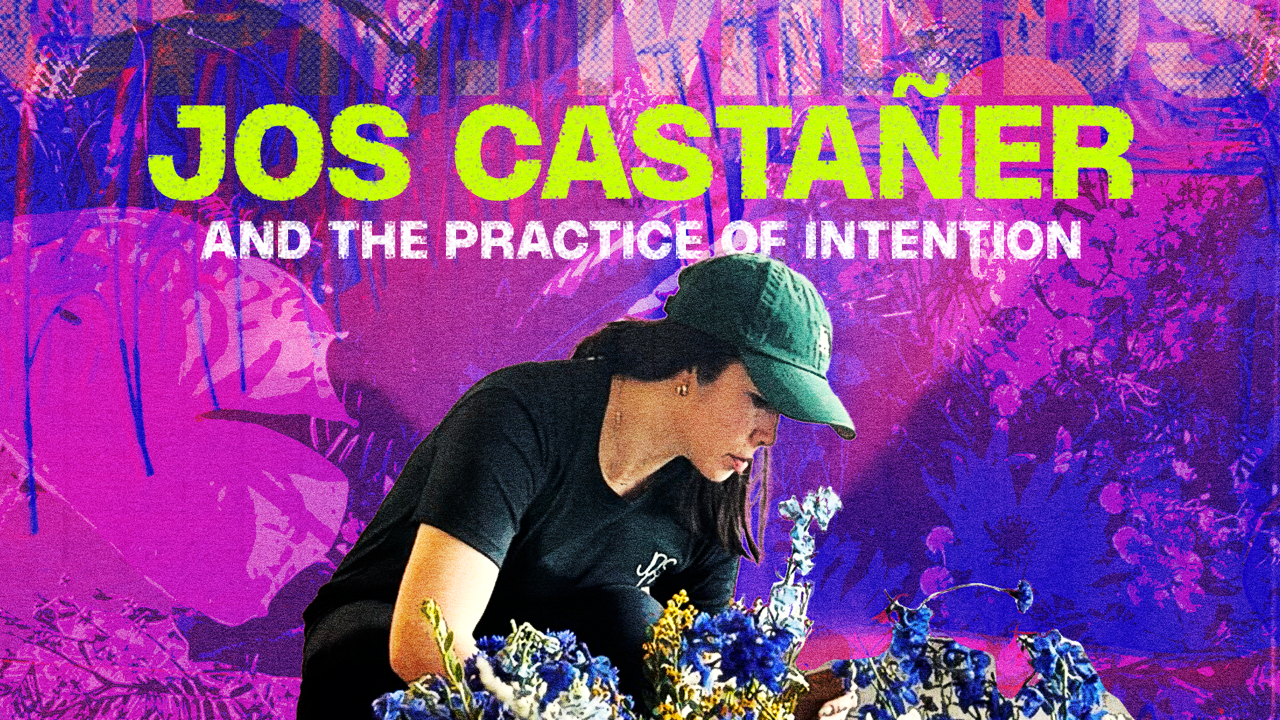
JOS CASTAÑER AND THE PRACTICE OF INTENTION
Long before floristry became her medium, Jos Castañer was already curating.
As a child, she collected objects with care. Vases, candles, small details that made a space feel considered. Years later, in her own home, that instinct remained. It wasn’t about decoration as much as it was about placement, about how things lived together.

Flowers came into the picture almost accidentally.
She had received a bouquet for her birthday, made up of Australian native stems. Instead of throwing them away, she decided to rework them using the pieces she already had at home. She placed them in her own vases, adjusted them, lived with them. Then she shared a photo.
People started asking where they could get the arrangement. Some wanted to buy it. Others asked her to recreate it.
What began as a simple act of rearranging turned into something else entirely. “I realized I had an eye for it,” she says.
From there, Jos Curates took shape. The name itself was already a reflection of how she saw the world as someone who gathers, refines, and brings elements together with intention.
Today, her work sits across disciplines. Floristry, photography, spatial design, interior styling. Each one feeds into the other but the foundation remains the same. A sensitivity to detail, and a need to make things feel right.
FORM, FLOW, AND AWARENESS
Floristry is often mistaken as something purely decorative. For Jos, it’s a process that requires both restraint and awareness. Every arrangement begins with a decision.
“There’s a reason why every stem is placed where it is,” she explains.
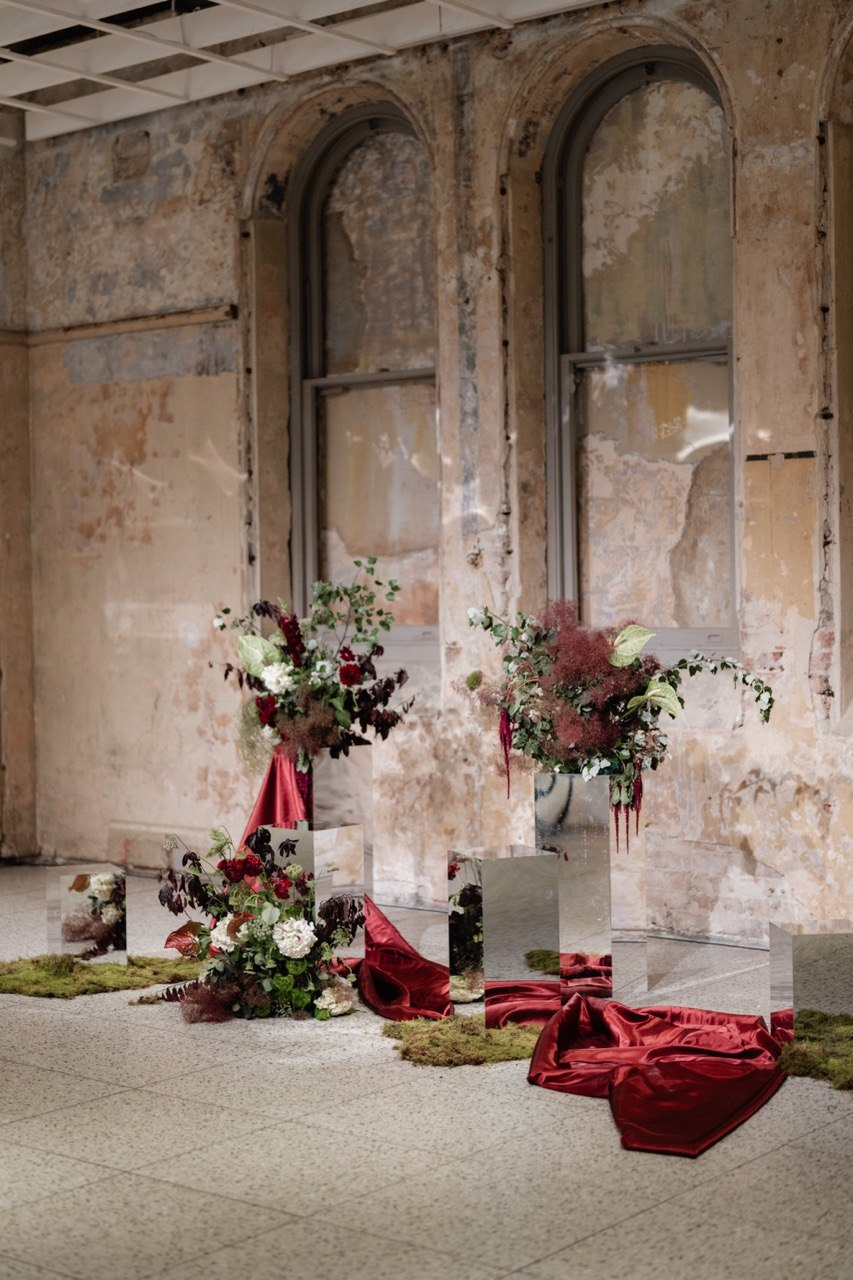
Her approach leans toward what she describes as contemporary and timeless. She pays attention to the natural form of each flower, letting it move the way it’s meant to instead of manipulating it into something unnatural.
There’s a quiet discipline behind it. Knowing when to step in, and when to let the material speak for itself.
Over the years, her visual language has also evolved. She started with softer palettes, more muted tones. Now, she’s more open to contrast. Color blocking. Unexpected combinations.
“The shift came from the experience of being not afraid to keep trying,” she says. “And allowing yourself to grow.”
Her process reflects that same openness. Clients bring moodboards, references, ideas. She studies them and then interprets.
“I ask myself how I can deliver this in my own way,” she explains. “How can I elevate it?”
Like a chef working with available ingredients, Jos builds based on what is in season, what is accessible, and what feels right in the moment. No two arrangements are meant to be the same. Each one carries its own story.
ROOTED IN TWO WORLDS
Jos grew up between the Philippines and Australia, moving at a young age but never losing connection to either.
“I am a Filipina as much as I am an Australian,” she describes herself, saying that the duality shows up naturally in her work. In Australia, she found space to explore. A creative environment that allowed independence and experimentation. In the Philippines, she found abundance. A climate that supports her medium and a community that moves with energy and scale.
“The Philippines is more is more,” she says. “Australia is more refined, more restrained.”

Instead of choosing one over the other, she brings a sense of balance to her projects depending on where they live. Sometimes that means pulling back, letting a space breathe. Other times, it means embracing fullness.
Her Filipino identity also shows up in more intentional ways.
She looks for opportunities to collaborate with local artisans, incorporating traditional techniques into her work. In one project, she worked with materials that used abaca weaving to form floral elements, creating arrangements that carried both craft and culture.
It’s a way of giving back while continuing to create.
“I want to support communities through what I do,” she says.
MEMORY AND MAKING
Some of her earliest memories of flowers trace back to her grandmother’s garden.
Orchids, carefully tended. A space that introduced her to beauty at a young age without her fully realizing it. Years later, those memories resurface in quieter ways.
And so do the people she has lost.
Jos speaks about grief with a kind of clarity. How certain relationships, like the one she had with her mother-in-law, were built around shared moments with flowers. How losing them changed the way she approached her work.
Creativity became a release. A place to process, to step away, and to return to something grounding.
“It takes a lot out of you,” she says. “But it also gives you a way to move through it.”

Those layers of experience don’t always appear directly in her arrangements but they shape the way she works. The care she brings into each piece. The awareness that what she creates, even briefly, holds meaning.
COMMUNITY AS PRACTICE
Despite the solitary nature people often associate with floristry, Jos has never built her work alone.
Community plays a constant role in how she moves.
In both Australia and the Philippines, she’s found herself surrounded by creatives who share knowledge, resources, and support. Industry partners who exchange advice. Friends she can call when things go wrong on site. People who understand the pace and pressure of the work.
“It’s a tiring industry,” she admits. “Things go wrong all the time.”
In those moments, community becomes necessary. She carries that same mindset into how she gives back. When flowers begin to wilt after an event, she finds ways to extend their life. Offering them to friends who can still use them for free. Sharing resources and passing things forward instead of letting them go to waste.
It’s a small gesture but one that reflects a larger belief.
Support moves in cycles.
GIVE TO GAIN
For Jos, giving starts with the people closest to her, and that’s her team.

She invests time in teaching them, guiding them through her process, helping them understand how she curates. She gives them space to take on different roles, to find where they excel, and to grow within the work.
At the same time, she learns to step back. To trust their hands, not just her own.
“I put myself in their shoes,” she says. That mindset shapes the kind of culture she builds – one that values both output and care. Even in small ways, like making sure there’s good coffee on set, she creates an environment where people feel supported.
In return, she sees it in the work. In how her team carries the same design language, the same attention to detail.
What she gives, she gets back consistently.
TAKING UP SPACE QUIETLY
In the industry she moves through, Jos hasn’t felt a strong need to fight for space.
She recognizes that she has been given opportunities, platforms where her work is seen, where her voice is heard.
“That awareness translates into gratitude but also responsibility,” she says. “I want to use those spaces to open doors for others, to share knowledge with younger creatives, to make a path a little easier than it was when I started.”
“I feel lucky,” she adds. “So I want to give that back.”
THE DNA OF THE WORK
Ask Jos how she wants to be remembered, and her answer is simple: Kind. Generous. Someone people feel comfortable approaching.
But within her work, there’s another marker she hopes for and that’s recognition without explanation.
“I love when people can look at something and say, ‘That’s Jos,’” she says. “It’s about building a distinct language. A design identity that carries through every piece.”
For her, each arrangement is closer to an artwork than it is to a product. Something that, if placed in a gallery, could stand on its own.
If there’s one thing she’s still learning, it’s restraint. Knowing when something is finished.
Her instinct is to refine, to keep adjusting, to make things better but she’s learning that overworking can take away from the original beauty of a piece.
“When something is already beautiful, you don’t need to add more,” she says.
It’s a balance she continues to work through. Between control and trust. Between doing and letting go.
One arrangement at a time.

Author:
Next Up

%20-%20Website%20Thumbnail.jpg)