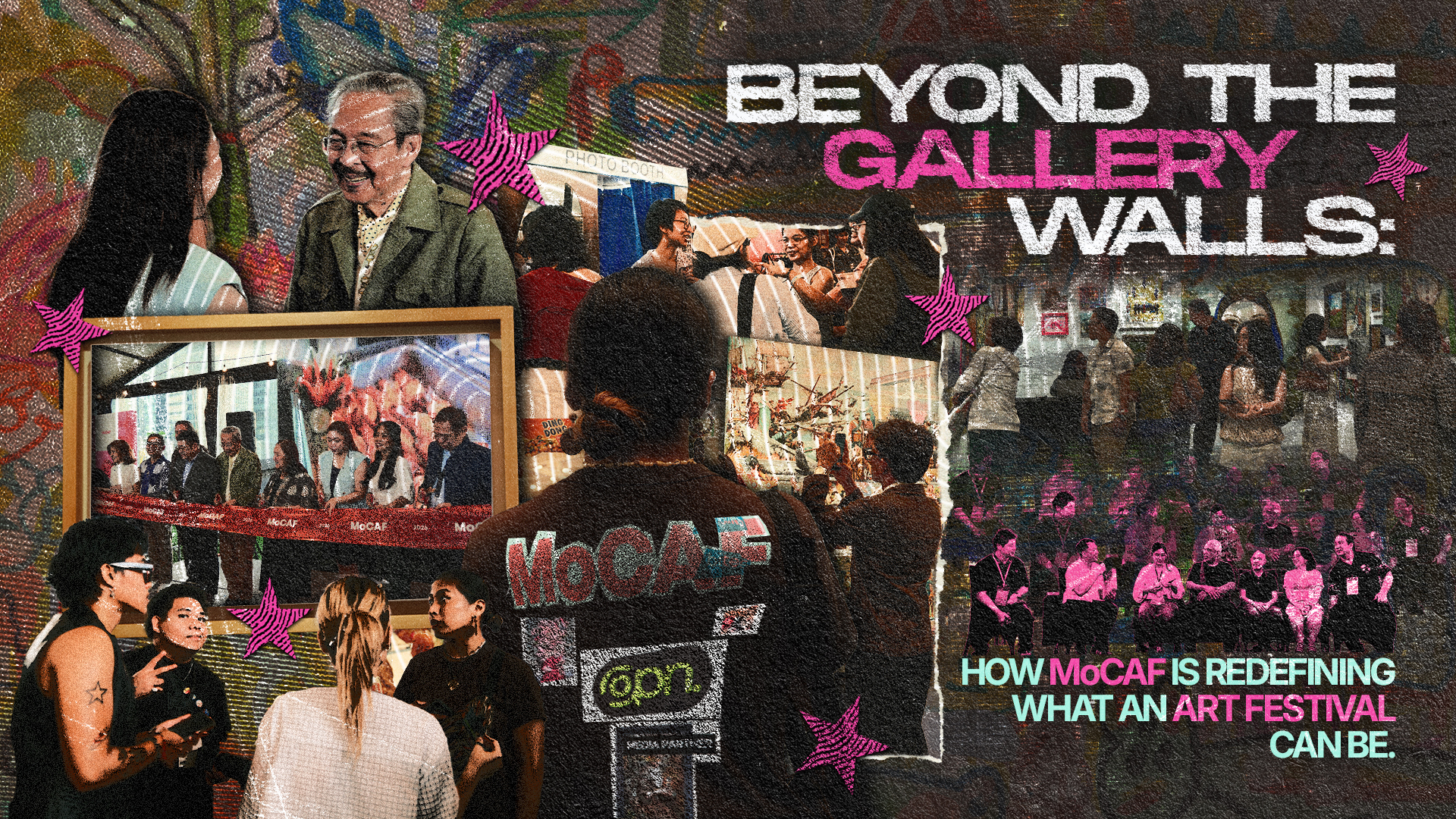
BEYOND THE GALLERY WALLS: HOW MoCAF IS REDEFINING WHAT AN ART FESTIVAL CAN BE.
What began as a showcase centered on galleries and exhibitions, Modern and Contemporary Art Festival (MoCAF) has steadily evolved into an ecosystem where visual artists, artisans, designers, food entrepreneurs, performers, educators, and audiences all occupy the same space. Walking through this year’s festival meant moving between exhibitions, creative workshops, artist talks, independent brands, and conversations that extended far beyond the artworks hanging on the walls.
For Festival Director Coleen Wong, the growth wasn’t something she expected.
“I actually didn’t think it would become this big,” she laughs as she reflects on MoCAF’s fifth edition.
“In the beginning, we focused on the usual exhibitions and paintings. But as the team kept brainstorming, we realized we shouldn’t enclose art to just visual arts. There’s so much more.”
That realization has shaped the direction of MoCAF over the past five years.
Instead of limiting itself to galleries, the festival gradually expanded to welcome new creative disciplines, giving space not only to artists, but also to artisans, designers, makers, performers, independent businesses, and audiences who may not have considered themselves part of the contemporary art world.
The result is a festival that feels less like a traditional exhibition and more like a creative city built for a weekend.
“We wanted to broaden our reach,” Wong explains. “Not just during the festival itself, but outside the festival walls, too.”
That vision has led to year-round pocket events, workshops, collaborations, and partnerships that continue long after the annual festival closes.
But perhaps the most noticeable expansion isn’t measured by the number of galleries or exhibitors, but the people.
Walk through MoCAF and you’ll find collectors standing beside students, first-time visitors attending their first workshop, families exploring installations together, designers browsing artisan booths, and curious passersby discovering artists they had never encountered before.
“It’s very diverse,” Wong says.
“Some people are interested in fashion, and then they get exposed to art. Others come for the art and discover different creative disciplines.”
Rather than asking audiences to fit into the traditional art world, MoCAF has quietly been reshaping the experience to meet people where they already are. That philosophy also shapes how Wong imagines the festival’s future.
“I hope MoCAF continues to be welcoming and inclusive,” she says. “But I also think it’s important to build more partnerships with other creative industries.”
For Wong, the future of Philippine contemporary art doesn’t depend on individual organizations growing independently, but on collaboration.
“The local art scene is very much alive,” she says. “There’s so much that we can do together. It’s important that we sit down, brainstorm, and think about how we can make the local art scene more friendly, more lively, and create more opportunities for everyone.”
That openness extends beyond the Philippines.
This year’s edition welcomed galleries from Japan, Spain, Malaysia, Hong Kong, and South Korea, while also hosting representatives from the Australian Embassy, reflecting MoCAF’s continued effort to strengthen international creative relationships.
“I think it’s our way of opening our doors,” Wong says. “Once you open the door, this is how we introduce our community. From there, we build those relationships.”
For Opn., that idea feels particularly significant because creative partnerships are rarely built through formal meetings alone. More often, they begin through shared experiences: a conversation after a workshop, a gallery visit, an unexpected collaboration, or simply discovering another creative community.
‘“It’s very important that we build these ties and strengthen them,” Wong adds. “We really learn from each other through the cultural exchange that we have.”
Perhaps, that is MoCAF’s greatest achievement after five years as it has become broader in what it believes art can be.
By welcoming different creative practices, industries, and communities into the same conversation, MoCAF continues to demonstrate that contemporary art is not confined to gallery walls. It grows wherever people are willing to create, collaborate, and remain curious about one another.
And maybe that’s what a creative ecosystem is after all. Not a collection of separate disciplines, but a network of people continuously opening doors for each other.
Author:
Next Up

%20-%20Website%20Thumbnail.jpg)